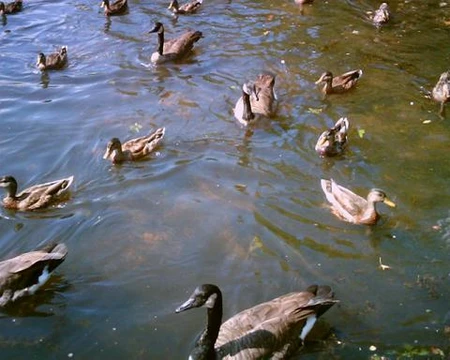
Coot
Medium-sized water birds with black plumage and distinctive frontal shields.

Coots are medium-sized water birds belonging to the rail family, Rallidae, and constitute the genus Fulica, a Latin term for 'coot'. They are notable for their predominantly black plumage and are often easily observed swimming in open water, unlike many other rails. Coots are found across Europe, North America, South America, Asia, Australia, and parts of Africa, with the greatest species variety occurring in South America, where the genus likely originated.
- Scientific name
- Fulica
- Family
- Rallidae
- Extant species
- 10
- Extinct species
- 1 recently extinct, plus several fossil species
- Type species
- Eurasian coot
- Group name
- Covert or cover
Lore & Background
Coots are characterized by prominent frontal shields on their foreheads, red to dark red eyes, and colored bills, with many species having white on the under tail. Their long toes have broad lobes of skin that fold back when lifting the foot, allowing them to walk on dry land and navigate mucky terrain. They have short, rounded wings and are weak fliers, though northern species can cover long distances, typically migrating at night. Coots congregate in large rafts in open water and may lay eggs in their own nests or in those of other birds, with egg colors varying by species: buff, pinkish buff, or buff-gray speckled with dark brown, purplish brown, or black.
Reader's Guide
Coots are omnivorous, feeding mainly on plant material but also on small animals, fish, and eggs. They are aggressively territorial during the breeding season but otherwise form sizeable flocks on shallow, vegetated lakes. Chick mortality is primarily due to starvation rather than predation, as coots struggle to feed large broods on tiny shrimp and insects. Many chicks die within the first 10 days, and under food pressure, parents may attack their own young after about three days, concentrating on weaker chicks who eventually give up begging and die. This behavior, called 'tousling,' can reduce a brood of nine to only two or three survivors. Fossil species include Fulica infelix from the early Pliocene of Oregon. In southern Louisiana, the American coot is known by the French name 'poule d'eau,' meaning 'water hen.'
Did You Know?
- A group of coots is called a covert or cover.
- Coots have long toes with broad lobes of skin that fold back when lifting the foot, aiding walking on land and in mud.
Taxonomic Home and Kinship
The coot occupies a specific niche within the avian classification system, belonging to the family Rallidae within the order Gruiformes. This places it alongside a diverse assemblage of birds including cranes, rails, crakes, moorhens, finfoots, and limpkins, all of which share the broader Gruiformes lineage. The Rallidae family grouping is notable for its ecological diversity, spanning species that range from more terrestrial wading forms to those more deeply committed to aquatic environments. Within the broader waterbird category, the coot sits in a taxonomic neighborhood that reflects a shared evolutionary history with these relatives, even as their specific ecological roles may diverge. The classification of waterbirds themselves is not without ambiguity—some definitions restrict the term to freshwater species while others encompass marine birds—yet the coot's placement in Rallidae and Gruiformes remains a stable anchor in ornithological taxonomy, distinguishing it from orders like Anseriformes (ducks, geese, swans) or Charadriiformes (shorebirds, gulls).
Aquatic Adaptations and Lifestyle
As a member of the waterbird group, the coot is shaped by the selective pressures of living on or around water. The broader category of aquatic birds exhibits a spectrum of adaptations, from webbed feet and specialized beaks to legs modified for feeding in water and the capacity to dive from the surface or even from the air to capture prey. Where the coot falls on the spectrum between more terrestrial wading forms and fully aquatic waterfowls depends on its specific ecological niche, but its Rallidae kinship with rails and moorhens suggests a lifestyle that bridges both realms. The defining evolutionary theme across waterbirds is the refinement of feeding techniques, and the coot, like its relatives, would be expected to display morphological features—beak shape, leg structure, toe webbing—that reflect an intimate relationship with aquatic environments. These shared adaptive patterns appear repeatedly across unrelated waterbird lineages, pointing to convergent evolutionary pressures rather than a single common aquatic ancestor.
Conservation and Wetland Dependency
The coot's survival is inextricably linked to the health of wetland ecosystems, and it falls squarely within the scope of international waterbird conservation frameworks. In conservation terminology, the term waterbird encompasses any species that inhabits or depends on bodies of water or wetland areas, a definition that places the coot under the umbrella of agreements like the Agreement on the Conservation of African-Eurasian Migratory Waterbirds. In the United States, organizations such as Ducks Unlimited—boasting 700,000 members and raising over $200 million annually, with at least 80 percent directed to habitat conservation—have protected at least 15 million acres of waterfowl habitat. The U.S. Fish and Wildlife Service's Waterbird Conservation for the Americas initiative further promotes international cooperation to preserve such habitats. A 2018 global study covering 461 waterbird species found that ineffective governance strongly predicts population declines, a finding with direct implications for coot populations in regions where wetland protection remains politically or institutionally weak.
Genetic Classification and Evolutionary Context
Modern molecular tools have refined how scientists understand the coot's place among aquatic birds. Mitochondrial gene sequencing, analyzed through relative apparent synapomorphy analysis, has become a key method for classifying and differentiating waterbird lineages. This genetic approach has helped clarify relationships within and between orders, identifying outgroups and confirming or challenging traditional morphological classifications. For the coot specifically, its placement in Rallidae within Gruiformes is supported by these broader phylogenetic frameworks, which also illuminate shared evolutionary pathways with cranes, rails, and other Gruiformes members. The evolutionary history of waterbirds is largely a story of convergent adaptation: flamingos and ducks independently evolved similar filter-feeding strategies, and the shoebill developed a morphology echoing that of wading birds. The coot, nestled among rails and moorhens in Rallidae, represents one thread in this tapestry of repeated aquatic specialization, its genetic signature a record of millions of years of selection for life at the water's edge.
Frequently Asked Questions
Who is Coot?
Coot is a medium-sized waterbird in the rail family (Rallidae), classified under the genus Fulica—a Latin word meaning 'coot.' It is best recognized by its solid black plumage and a distinctive bony frontal shield on the bill, with the Eurasian coot serving as the type species.
What are Coot's powers/role?
Unlike most rails that stay hidden in reeds, coots are highly visible swimmers that patrol open water in plain sight. They range across Europe, North America, South America, Asia, Australia, and parts of Africa, making them one of the most geographically widespread waterbird genera.
How does Coot's story end?
The genus currently numbers 10 living species, though one has recently gone extinct and several additional species are known only from fossils. South America holds the richest concentration of extant coot species and is likely where the genus first evolved.
Why is Coot important?
Coots stand out among rails because they thrive in open aquatic habitats rather than dense marsh cover, making them far easier for observers to spot. Their wide distribution and open-water lifestyle give them a prominent role in wetland ecosystems on nearly every continent.
What is Coot's group name?
A gathering of coots is called a 'covert' or a 'cover.' The scientific genus name Fulica simply translates to 'coot' in Latin.
More in Birds Of Prey And Waterbirds 1-24
Spotted an error? Know more?
This is a living reference — every entry is fact-audited, and reader corrections feed straight into our audit queue. Suggest an edit · See this site's audit record