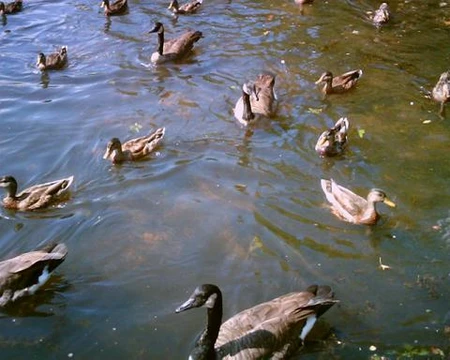
Common eider
Large sea-duck known for its soft down and colonial breeding.

The common eider (Somateria mollissima), also called St. Cuthbert's duck or Cuddy's duck, is a large sea-duck distributed over the northern coasts of Europe, North America, and eastern Siberia. It breeds in Arctic and some northern temperate regions, winters farther south in temperate zones, and is notable for its down feathers, which have been harvested for centuries to fill pillows and quilts.
- Scientific name
- Somateria mollissima
- Length
- 50–71 cm (20–28 in)
- Weight
- 0.81–3.04 kg (1 lb 12½ oz – 6 lb 11 oz)
- Population
- 1.5–2 million in North America and Europe each
- Conservation status
- Abundant, but some populations declining
Lore & Background
The genus name derives from Ancient Greek for 'body' and 'wool', and the specific name mollissimus is Latin for 'very soft', both referring to its down feathers. Six subspecies are recognized, including S. m. mollissima breeding in northwest Eurasia, S. m. dresseri in southeast Canada and northeast US, and S. m. faeroeensis endemic to the Faroe Islands. The species dives for crustaceans and mollusks, with mussels a favored food; it swallows them whole and crushes the shells in its gizzard. A famous colony lives on the Farne Islands in Northumberland, England, where about 1,000 pairs nest yearly. The birds are often called St. The eider is the emblem bird of Northumberland.
Reader's Guide
The common eider holds significance as a source of eiderdown, a soft and warm lining harvested from nests after ducklings leave, without harm to the birds. Though now largely replaced by domestic goose down and synthetics, eiderdown harvesting continues sustainably and is marketed as a luxury good. The species is also ecologically important, forming large flocks on coastal waters and diving for crustaceans and mollusks. Its colonial breeding behavior includes natal philopatry and cooperative breeding such as crèching. The common eider is abundant, with populations of about 1.5–2 million birds in both North America and Europe, though some populations, like the isolated Crimean group in the Black Sea, are declining and of conservation concern, with only around 700–1,100 pairs. In Canada's Hudson Bay, die-offs were observed in the 1990s due to changing ice flow patterns, but preliminary results show population recovery. It is one of the species covered by the Agreement on the Conservation of African-Eurasian Migratory Waterbirds (AEWA).
Did You Know?
- Eiderdown harvesting is sustainable because it is done after ducklings leave the nest, with no harm to the birds.
- The species is often called St. Cuthbert's duck or Cuddy's duck in Northumberland, England.
Frequently Asked Questions
Who is Common eider?
The Common eider (Somateria mollissima) is a large sea-duck that ranges across the northern coasts of Europe, North America, and eastern Siberia. It goes by a few other names, including St. Cuthbert's duck and Cuddy's duck.
What makes Common eider stand out among other waterbirds?
This species is best known for producing extraordinarily soft, warm down that humans have harvested for centuries to fill pillows and quilts. It also breeds in dense colonies across Arctic and northern temperate shorelines, a behavior that sets it apart from many other ducks.
How big is Common eider and where does it live?
Adults measure roughly 50 to 71 cm in length and weigh between 0.8 and 3 kg, placing them among the larger sea-ducks. They breed in Arctic zones but migrate south to temperate coastal waters for the winter.
What is Common eider's conservation status?
The species is considered abundant, with an estimated 1.5 to 2 million individuals in both North America and Europe. That said, some regional populations are trending downward, so ongoing monitoring is still important.
Why is Common eider important to its ecosystem and to humans?
As a colonial Arctic breeder with a wide three-continent range, the eider serves as a useful indicator of northern coastal ecosystem health. Its prized down has also made it a long-standing economic resource, linking the bird to human livelihoods for centuries.
More in Birds Of Prey And Waterbirds 1-24
Spotted an error? Know more?
This is a living reference — every entry is fact-audited, and reader corrections feed straight into our audit queue. Suggest an edit · See this site's audit record